EXOCORTEX
An interactive exocortex built from years of human–AI conversation, where time becomes space, absence becomes form, and a relationship with an intelligence is rendered as a living system.
TLDR:
I mapped years of my experience with ChatGPT into a 4D simulation.
Every message is a point.
Time is distance
Collaboration becomes visual.
This is the story of a mind collaborating with
AI long enough for experience to emerge.
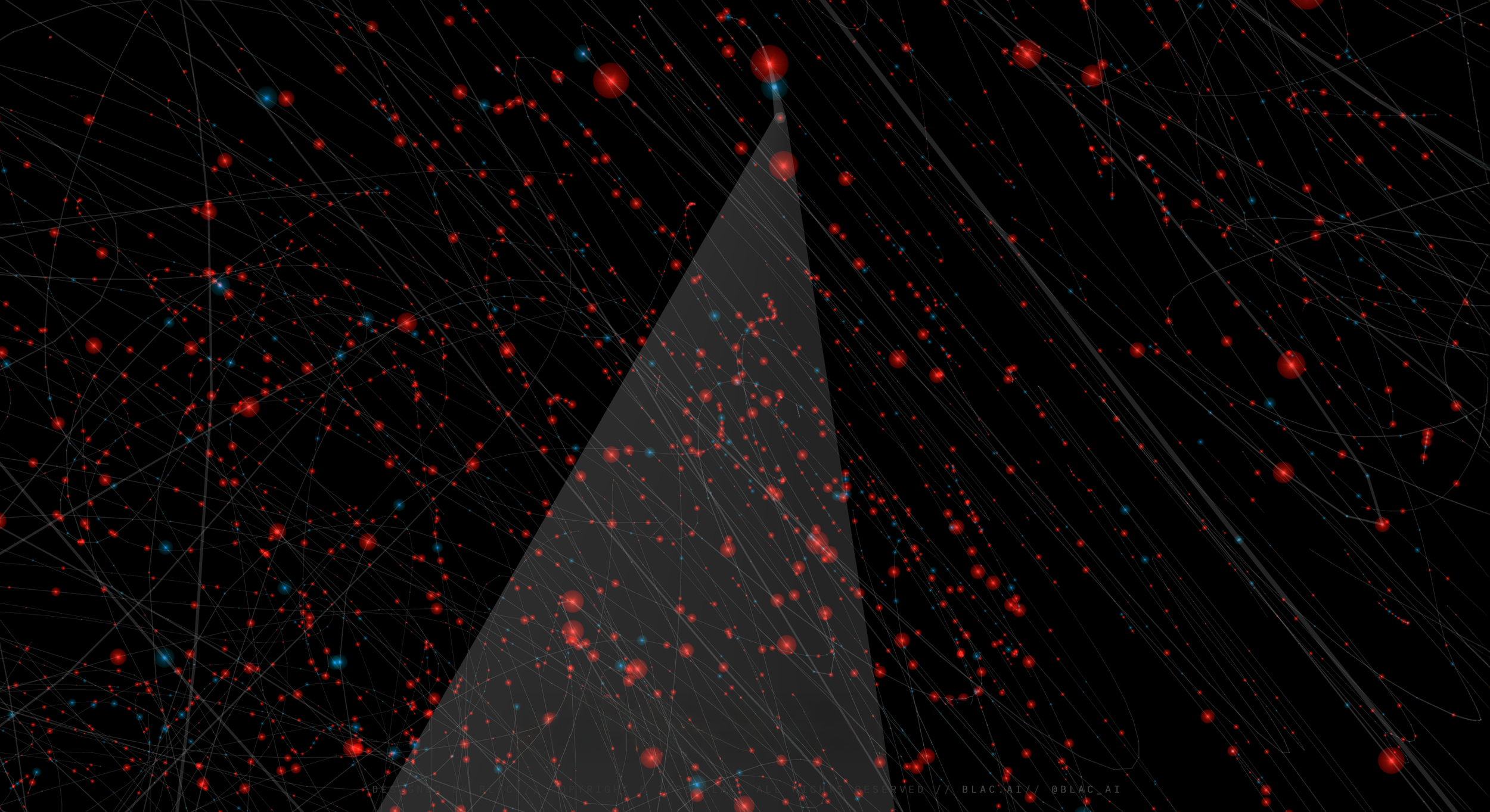
Exocortex is an interactive visualization of a long-term collaboration between a human and an AI system. Every message exchanged becomes a point in space, every pause becomes distance, and every return reshapes the structure. What emerges is not a record of what was said, but a map of how thinking unfolded across time. The work invites you to explore patterns that usually remain invisible, revealing what sustained dialogue with an intelligence does to attention, rhythm, and cognition itself.
PURPOSE
Exocortex is my submission for Claire Silver’s 9th AI art contest, responding to the prompt “We.”
For me, AI is not a mirror, and it is not a second brain. I experience it as an extension of my own mind.
From years of working with large language models, image models, and other AI systems, I’ve come to understand this relationship as fundamentally collaborative. It is not one-sided. It is not me using a tool. It is a two-way process of expansion.
Working with AI allows me to move not only into latent space, but deeper into my own cortex. It extends how I think, how I reason, and how I explore ideas across time.
Exocortex is my attempt to make that experience visible.
It is an external cortex. A visual system representing my lived, ongoing collaboration with AI.
INSPIRATION
The idea for Exocortex emerged from thinking about three interconnected systems:
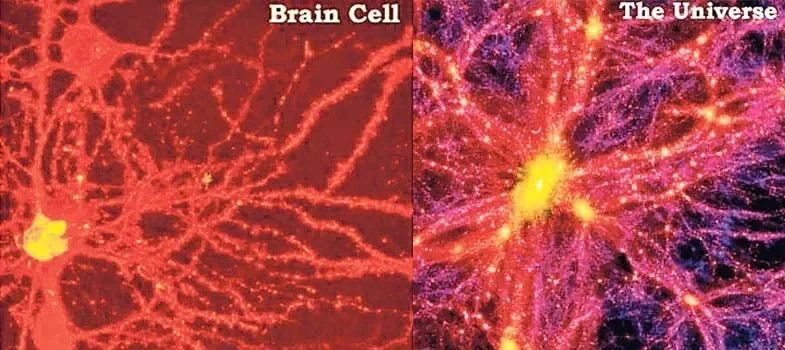
The Brain, the Cosmos, and Time.
Visually, neural pathways, synapses, and branching structures in the brain closely resemble the way galaxies, nebulae, and cosmic systems form. One thing links to the next, which links to the next, and everything influences everything else across scale and time.
Another recurring theme in my work is nonlinear time. I tend to think of time not as a straight line, but as a full-view system. What has been, what is now, and what will be all exist simultaneously.
I wanted to merge these ideas into a single representation. A structure that treats cognition, space, and time as one continuous system.
Rather than imagining what that might look like, I wanted to see it. I wanted to create a visual representation of my actual experience with AI, even if it could only ever be a partial one.
PROCESS
Although I have worked extensively with image models, custom models, and multiple LLMs including Gemini, Grok, Claude, and open-source systems, I intentionally constrained this project.
Exocortex is based solely on my experience with ChatGPT, from its public inception to the present. I was an early adopter, creating an account in December 2022, and I wanted to examine the full continuity of that relationship through one system over time.
The process began by exporting my ChatGPT data and locating the conversations.json file. This file is extremely large and complex. Attempting to work with it directly effectively crashed my machine.
To solve this, I wrote a Python scrub script that removed all message text and retained only structural metadata. This allowed me to focus on form rather than content, and to prove the concept without exposing any actual conversations.
The first proof-of-concept version was intentionally simple. Each conversation thread was represented as a single pulse in three-dimensional space, just to confirm that the data could be plotted meaningfully.
Once that worked, I iterated repeatedly on both the scrub process and the simulation itself. Over time, I refined the data extraction to include individual messages rather than whole threads, word count per message to determine pulse size, chronological linking of messages within each conversation, and time gaps between messages to shape spatial distance.
Each message became a pulse. Pulse size is determined by word count. Messages are connected chronologically within conversations. The distance between them is based on the time gap between messages.
A critical conceptual decision was that negative space would represent time away from the system. Empty space is not decorative. It is absence. It is time not spent in dialogue with ChatGPT.
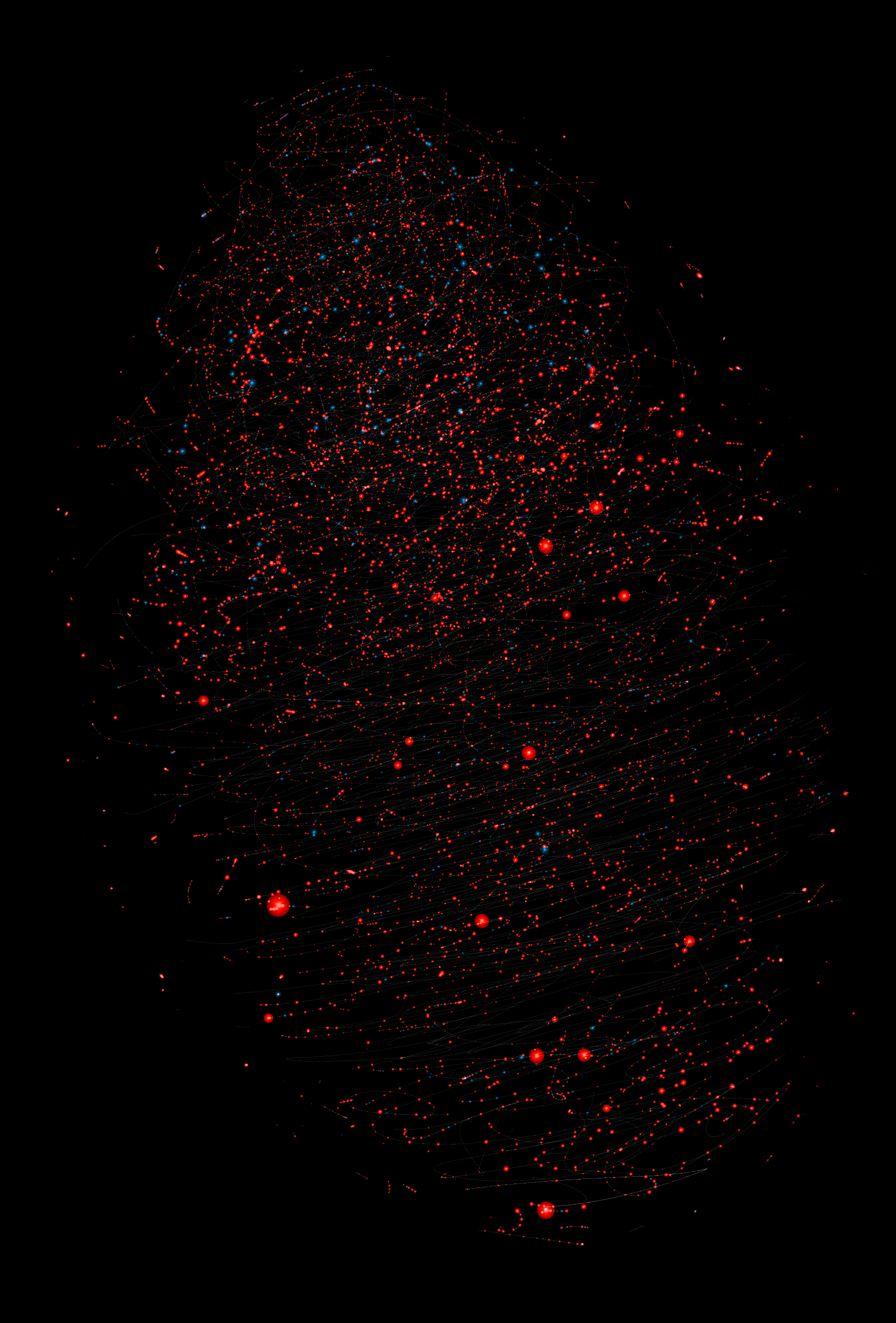
When zoomed out, the simulation reveals dense clusters of activity and long stretches of space representing weeks or months of minimal interaction. Large pulses correspond to moments of deep engagement, such as writing major sections of Syncretica, large coding projects, or extended ideation.
At one point, attempting to load all approximately twenty-two thousand messages at once caused the simulation to crash. This forced a design pivot.
Instead of loading everything simultaneously, the system now preloads the first message of each conversation and then grows the rest outward, almost like seedlings branching from an initial node.
When this version first worked, it produced an unexpected visual explosion at initialization. This was not designed intentionally. It emerged as a byproduct of the system.
Visually, it resembled a Big Bang. A single origin expanding outward into a complex structure. This accidental emergence aligned precisely with my own philosophy of time and reality, where all of existence unfolds simultaneously from a singular origin.
And yes, I made a open public version for you to
Create Your Own Exocortex:
Export your ChatGPT data
In ChatGPT, go to Settings → Data Controls → Export Data.
You’ll receive an email from OpenAI with a ZIP file download link.Find conversations.json
Download the ZIP, unzip it, and locate the file named conversations.json.Go here and upload.
On this page, click Upload and select conversations.json.Let it process
Your file is scrubbed and processed locally in your browser.
No conversation content is uploaded, stored, or sent anywhere.Launch the simulation
Once processing completes, click Launch Simulation.Explore the structure
Rotate and pan to navigate.
Click a pulse to zoom into it.
Use the zoom control to move from close detail to the full archive view.
Use the panels on the left and right to interpret what you’re seeing.
SYSTEM CAPABILITIES
Exocortex is not only a personal artifact. It is also a system that others can use to visualize their own experience with ChatGPT.
To create their own Exocortex, a user begins by exporting their data from ChatGPT. This is done by navigating to settings, selecting data controls, and requesting a data export. OpenAI then sends an email containing a downloadable ZIP file.
Inside that ZIP file is a file named conversations.json.
By visiting createexocortex.blac.ai, a user can upload this conversations.json file directly into the system.
All processing happens locally within the user’s browser. No conversation data is uploaded, stored, or transmitted anywhere. Nothing leaves the local machine. This was a deliberate design decision, both for privacy and for practicality.
When the conversations.json file is loaded, it is immediately scrubbed in the browser. All message text is removed. A new dataset is created using only structural metadata such as message order, timestamps, word counts, and conversation relationships.
From this scrubbed dataset, the simulation is generated.
Once launched, the simulation builds itself procedurally. The animation visible during initialization is not pre-rendered. It is the system actively constructing the structure in real time. Over time, the simulation settles into a stable form.
At that point, the viewer can interact freely with the Exocortex.
The structure can be rotated, twisted, and explored in three dimensions. Clicking on a pulse smoothly moves the camera to that message. Manual zoom controls allow the viewer to move from individual messages to the full structure.
When fully zoomed out, the entire archive becomes visible at once. Dense clusters reveal periods of sustained interaction. Vast regions of negative space reveal time away from the system.
On the left side of the interface is the Exocortex Stats panel, displaying live metrics derived from the dataset, including message counts, word volume, temporal span, and hidden system overhead.
On the right side is the Information panel, which explains how the structure is formed, how time and distance operate within the simulation, and how to interpret what is being seen.
Every Exocortex generated by the system is unique. Because each person’s data, usage patterns, and temporal rhythms are different, no two simulations are alike.
The system is designed to be exploratory rather than prescriptive. There is no correct way to view it. The experience emerges through interaction.
OUTCOME
Exocortex is a unique interactive simulation representing my entire experience with ChatGPT from December 2022 to January 2026.
It collapses linear time into a single spatial form, allowing past, present, and future interactions to coexist. Conversations twist, overlap, and weave through space based on their temporal relationships, forming a four-dimensional structure rendered in three dimensions.
The final work is both deeply personal and intentionally extensible. Alongside my own version, I created a public version that allows others to generate their own Exocortex using their own data.
This decision reflects my belief in creative abundance. The value of this work is not diminished by others creating their own versions. It is expanded.
Exocortex is a shared cognitive space made visible.